
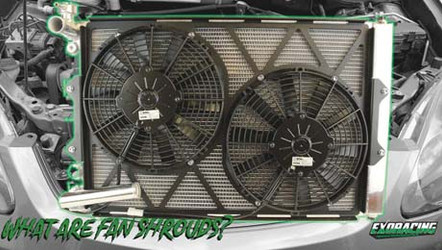
What Is A Radiator Fan Shroud? Cooling Guide
Posted by Matthew Marks on 1st Aug 2024
What Is A Fan Shroud And Why Are They Used?
A radiator fan shroud helps the fan pull air through more of the radiator core, which matters most when the car is stationary, moving slowly, or carrying more heat than the factory cooling system was designed for.
Exoracing is a UK heat management and performance parts specialist, helping modified car owners and workshops solve real cooling and engine bay heat problems since 2018.
Shop Radiator Fan ShroudsIf your car runs hot in traffic, after repeated hard pulls, or during low-speed track and drift use, the fan and shroud are worth checking before you start buying random cooling parts.
The radiator removes heat from the coolant, but it can only do that properly when air passes through the core. At road speeds, vehicle movement helps force air through the radiator. At idle or low speed, the fan has to do the work.
This guide explains what a fan shroud does, when you need one, when it will not fix the real problem, and how to choose a fan and shroud package without wasting money.
The simple answer
A radiator fan shroud is a panel or housing that sits around the fan and helps direct airflow through the radiator core instead of letting the fan pull air from the easiest gap around it.
Without a shroud, the fan mostly works on the circular area directly in front of the blades. With a suitable shroud, more of the rectangular radiator core is used, which can improve cooling efficiency at idle, in traffic, and during low-speed, high-load driving.
A shroud is not a magic fix for every overheating issue. Blocked radiators, trapped air, poor coolant flow, wrong fan wiring, bad thermostats, and trapped engine bay heat can still make the car run hot.
- A fan shroud helps the fan pull air through more of the radiator core.
- A fan without a shroud can still cool, but it often uses less of the radiator surface area.
- Modified, turbocharged, track and drift cars usually expose cooling weaknesses sooner than standard road cars.
- The shroud, fan size, fan direction, radiator condition and coolant bleeding all need to work together.
- If the car still runs hot after a fan upgrade, diagnose the rest of the cooling and heat management system.
What Does A Radiator Fan Shroud Do?
A fan creates a low-pressure area behind or in front of the radiator, depending on whether it is a pull or push fan. Air always takes the easiest route, so if there are open gaps around the fan, some of that air can come from around the radiator instead of through it.
The shroud helps control that airflow path. Instead of the fan only pulling through the small circle covered by the blades, the shroud encourages air to move through a larger area of the core.
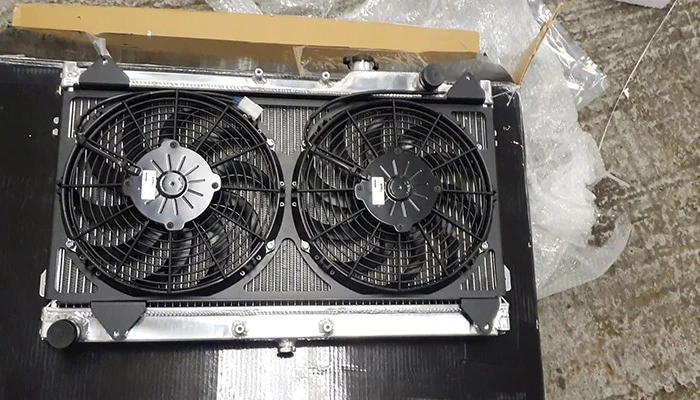
This is why a shroud is especially useful when there is not much natural airflow through the front of the car. Traffic, paddock idling, drift queues, dyno time and slow technical sections on track all put more responsibility on the fan and shroud.
For a wider breakdown of fans, size, CFM, and push versus pull layouts, see our guide on how to choose the right radiator fan.
Can You Use A Fan Without A Shroud?
Yes, a fan can work without a shroud, but it is usually less efficient. On a lightly used road car in cool weather, you might not notice the difference. On a modified car with more heat load, the weakness normally appears when the car is stationary or moving slowly.
The risk is not that the fan suddenly stops moving air. The risk is that it moves air through the wrong area, leaving too much of the radiator core underused when you need cooling most.
Best avoided where idle, traffic, or low-speed cooling is already marginal.
A stronger choice for modified road, track and turbo cars where cooling headroom matters.
Bad sealing, wrong spacing, wrong fan direction or core contact can undo the benefit.
When Is A Fan Shroud Upgrade Worth It?
A fan shroud upgrade is worth considering when the car struggles with low-speed cooling, has more heat load than standard, or needs extra engine bay clearance around the radiator area.
Modified cars often make the cooling job harder. A turbo conversion can add heat to the bay. A front-mount intercooler can reduce clean airflow to the radiator. A thicker radiator can improve heat capacity but reduce space. Track and drift use can keep the car hot for longer than normal road driving.
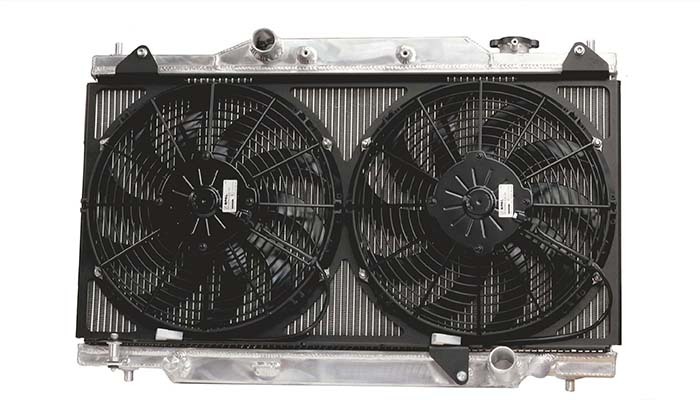
A slim fan and shroud package can also create useful room between the radiator and engine. That extra space can make maintenance easier and reduce the chance of hoses, wiring or intake pipework being squeezed close to hot or moving parts.
If the wider issue is engine bay heat rather than coolant temperature alone, our guide to automotive heat management explains how airflow, heat soak and component protection work together.
How To Choose The Right Fan And Shroud Setup
Start with the problem, not the biggest CFM number you can find. A good setup needs the right fan type, suitable airflow, sensible spacing, and a shroud that works with the radiator and engine bay layout.
Low-speed motorsport and repeated hard use need more cooling headroom than normal road use.
Pull fans are usually preferred behind the radiator where space allows; push fans help where rear clearance is tight.
Thicker radiators, intercoolers in front of the core, turbo builds and hot climate use may need a stronger fan package.
Check radiator compatibility, fan depth, plug direction, hose clearance and whether the kit excludes specific radiator brands.
Our fan shroud kits are designed around practical fitment details such as radiator position, fan surface area, airflow, slim depth and secure mounting. On relevant kits, we design the fan to sit close to the radiator core while allowing clearance so vibration or movement does not damage the core.
Example fan shroud options
Use these as verified example fitments. Always check the product page notes before ordering, especially if your car has a non-standard radiator, custom engine swap, intercooler pipework or unusual wiring route.
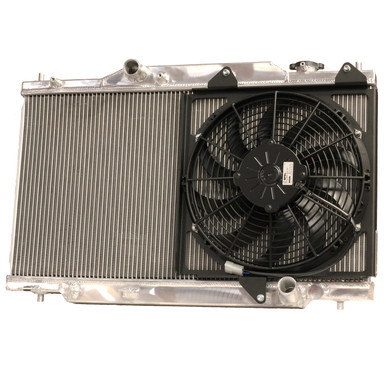 Radiator Fan Shroud 1220Cfm Spal For Honda Civic Ep3
A slim EP3 fan and shroud package for cleaner radiator airflow control and improved engine bay clearance.
From £127.20
 Radiator Fan Shroud 1330Cfm Spal For Honda Civic 92-00
A higher-output Civic 92-00 option for builds that need more cooling headroom under harder use.
From £273.60
 Radiator Fan Shroud 1560Cfm Spal For Mazda Mx5 Mk1 90-98
A Mazda MX5 Mk1 package that suits common cooling upgrades and has a supporting installation guide.
From £190.80
How Fan Shrouds Are Designed
The shroud design process starts with the radiator, not a universal plate. Then use an original or popular aftermarket radiator as the basis, scan or model the fitment, then choose a suitable fan based on airflow and the available fan surface area.

The fan is positioned to sit close to the core, while still allowing safe clearance. On our shroud kits, the target spacing is approximately 3-5mm away from the radiator core surface, which helps airflow while reducing the risk of contact under vibration or hard use.
The shrouds are laser cut from 3mm aluminium, CNC folded for consistent fitment, and finished with a textured high-temperature powder coat. We also use flush press-fit studs, so there are no sharp fixing edges underneath the shroud that could damage the radiator core if contact occurred.
Watch: In our MX5 cooling upgrade video, we show the radiator and fan shroud package fitted on a real car, which is useful if you want to see the layout before ordering parts.
When A Fan Shroud Is Not The First Fix
A fan shroud helps airflow through the radiator, but it cannot fix every cooling issue. Before buying parts, identify whether the heat problem is coolant temperature, engine bay heat soak, or a fault in the cooling system.
If the car overheats after a coolant change or radiator swap, bleed the system properly and check for trapped air. If it gets hot at motorway speed, inspect the airflow through the front of the car and the radiator condition. If hoses, wiring or intake parts are suffering from radiant heat near a turbo, manifold or downpipe, you may need source control and component protection as well as cooling airflow.
Heat management works best in order: identify the heat source, identify the vulnerable part, check routing and clearance, control the heat source where possible, protect the vulnerable part, then recheck after heat cycles. Our guide to engine bay heat transfer explains conduction, convection and radiant heat in more detail.
If you are trying to diagnose a wider heat issue, our guide to common engine bay heat problems and simple solutions is the better next step.
Common Fan Shroud Mistakes
Choosing a fan by CFM alone
CFM matters, but fitment, fan direction, shroud design, radiator condition and electrical control matter too. A high-output fan fitted badly can still give poor results.
Ignoring fan direction
A pull fan should pull air through the radiator from the front of the car towards the engine bay. A push fan should push air through from the front side. If the polarity, blade type or mounting direction is wrong, the fan can fight the natural airflow path.
Mounting parts too close to the radiator core
The fan and shroud need to sit close enough to work, but they must not contact the core. Check clearance carefully, especially on cars with hard mounts, engine movement, accident damage or non-standard radiator brackets.
Treating the shroud as the only cooling upgrade
If the radiator is blocked, the thermostat is faulty, the coolant system has air in it, or the engine bay traps hot air, a fan shroud will only solve part of the problem.
Forgetting wiring and fan control
A stronger fan may draw more current than the original setup. Check relays, fuses, wiring, fan switches and connectors rather than assuming the old wiring will always be suitable.
Fan Shroud FAQs
Is a fan shroud really necessary?
On many cars, yes. A shroud helps the fan use more of the radiator core, especially at idle and low road speed. Some cars can run without one, but it usually reduces cooling efficiency.
Will a fan shroud stop my car from overheating?
It can help if the problem is poor low-speed radiator airflow. It will not fix a blocked radiator, trapped air, coolant leak, faulty thermostat, weak water pump, incorrect fan wiring or severe engine bay heat soak on its own.
Is a pull fan better than a push fan?
A pull fan behind the radiator is usually the preferred layout where there is enough space, because it works with the natural airflow path. A push fan can still be useful when engine-side clearance is limited.
Does a fan shroud matter on a track car?
Yes, especially if the car spends time at low road speed, in paddocks, in drift queues, or recovering between sessions. Track cars can also suffer from heat soak after hard use, so fan control and engine bay airflow matter.
Can a fan shroud restrict airflow at speed?
A poorly designed shroud can create unnecessary resistance at higher road speeds. That is why shroud design, aperture shape and radiator coverage matter, rather than simply covering everything with a flat panel.
How close should the fan shroud be to the radiator?
It should sit close enough to control airflow but not touch the core. On our shroud kits, the design target is approximately 3-5mm from the radiator core surface, while still allowing safe clearance under vibration and hard use.
What should I check after fitting a new fan shroud?
Check fan direction, wiring, fuse and relay rating, hose clearance, radiator clearance, coolant leaks, coolant bleeding and whether the fan switches on at the correct temperature. Recheck fixings after heat cycles.
Conclusion
A fan shroud is there to make the radiator fan work more effectively by controlling where the air comes from. Instead of letting the fan pull air through one small area or around the core, a proper shroud helps use more of the radiator surface.
If your car gets hot in traffic, idles for long periods, runs a turbo conversion, has a front-mount intercooler, or sees track and drift use, a matched fan and shroud package can be a sensible cooling upgrade. Just make sure the rest of the system is healthy first.
Shop Radiator Fan ShroudsFor installation help, our Mazda MX5 Mk1 radiator and fan shroud installation guide shows the practical steps on a real car. The exact fixings and wiring can vary by vehicle, but the checks around fitment, bleeding and fan testing still apply.
About the Author

Exoracing is a UK-based heat management and performance parts specialist. Since 2018, we have helped enthusiasts and workshops choose parts for real modified cars, including turbo builds, track cars, drift cars, and tight engine bay layouts where cooling, airflow and heat protection need to work together.