

Rubber VS Polybushes: Which Is Right For You?
Posted by Matthew Marks on 1st Aug 2024
Rubber bushes and poly bushes both have a place, but the right choice depends on how you use your car.
If comfort, refinement and low noise matter most, rubber usually wins. If sharper handling, cleaner steering feel, and better suspension control matter more, polyurethane is often the better upgrade.
That is why there is no one-size-fits-all answer. A daily-driven road car usually wants a very different bush setup from a fast road build, drift car or track car.
In this guide, we will break down the real differences between rubber and polyurethane bushes, explain where each one works best, and help you decide what is worth fitting for your own car and driving style.
- Rubber is usually best for comfort and refinement
- Polyurethane is usually best for sharper handling and feedback
- Hardened rubber suits drivers who want a middle ground
- Spherical bushes suit serious track and race use more than daily driving
Why would I use polyurethane when most road cars come with rubber bushes?
Manufacturing costs and the desire to make cars as comfortable as possible are the main reasons rubber bushings are found on most road-going vehicles. Rubber bushings will help absorb harsh bumps and dampen road noise.
These are all properties that manufacturers will choose when selling cars designed to be used daily and on long journeys.
That does not mean rubber is bad.
In fact, fresh OEM-style rubber bushes are often the best choice for someone restoring a car or simply trying to get it driving nicely again. The problem is that standard rubber bushes are designed around compromise.
They allow more movement to keep the ride civilised, but that same movement can make the steering feel less precise and the suspension geometry less consistent once you start pushing harder.
However, suppose you are building or modifying a vehicle to be performance-focused, comfort and noise will be overshadowed by the all-out handling properties, and road feel found with Polyurethane bushings.
This is why polyurethane bushes are so popular on fast road and track builds.
They reduce the unwanted flex that can make a car feel vague when braking, turning in, or changing direction quickly. The result is usually a car that feels more tied down, more predictable, and more confidence-inspiring when driven hard.
How do Polybushes Improve Handling?

Your car's suspension components are all connected by the bushes, meaning that spending time getting the perfect alignment settings on your vehicle will be wasted when using rubber bushes, as they allow more unwanted movement of the suspension arms.
Think of it this way: alignment settings only work properly if the suspension holds them under load.
If the bushes flex too much, the wheel can move around more than you expect during braking, cornering, or acceleration. That means the car may not feel as accurate or consistent as the alignment sheet suggests.
Polyurethane bushes will hold their shape much more efficiently under intense cornering loads, keeping your alignment exactly where you want it.
That same principle is why many drivers pair bush upgrades with properly set-up coilovers, as both help the car stay more controlled and consistent when pushed harder.
That is one of the biggest reasons people notice an improvement straight away.
The steering often feels more direct, the front end responds faster, and the car can feel more stable when loaded up in a bend. It is not magic; it is just the suspension moving less where you do not want it to.
Not only will your alignment stay truer, but the feeling and feedback you receive as a driver will also increase hugely. Rubber bushes are designed to dull down the impact of the road for comfort. In contrast, on the track, you will want to feel everything that is going on underneath the car, giving more driver feedback and awareness of conditions and track surface.
The reduced unwanted movement of the steering arms will provide a much more direct steering feeling, again always giving the driver more information.
If steering feel matters to you, our guide on how to choose a steering wheel is a useful next read, especially if you want the car to feel more connected both through the suspension and through the wheel itself.
Superpro also offers a wide range of camber and castor bushes if you want to enhance your handling characteristics further.
Will I have any problems using Poly bushes?

Providing the manufacturer's instructions have been followed correctly during the installation of polyurethane bushes, they shouldn't need maintenance for at least five years.
After five years, some different types of bushes may need to be regreased. However, many kits now are so good that after being greased during installation, they have a good chance of outlasting the car's life.
As with any component under stress on your car, it will still be worth doing regular visual inspections, making sure the bushes are still correctly seated, and all the bolts are still done up to the manufacturer's specs.
Sometimes people complain about polyurethane bushes squeaking, but this usually comes down to incorrect installation, poor lubrication, or using lower-quality bushes.
A good quality kit fitted properly with the correct grease should not automatically be noisy.
That said, you should still expect a little more noise, vibration and harshness than a soft factory rubber bush, especially on rough roads or in stripped-out cars.
How do I know if my bushes need replacing?
Generally, on MOTs, play or movement in the bushes will be picked up on the inspection; however, there are some visual checks that you can do. Most conventional rubber bushes are constructed from a metal outer and inner bonded in place.
If you are refreshing more than just the bushes, our suspension guide is a good next step because it explains what else is worth checking or upgrading at the same time.
Over time, this can separate, and the bush will become ineffective. In addition to this, you will see if the bushes are perished or cracked on a visual inspection. Cracked or perished rubber will render them unusable or substantially softer.
Common symptoms of worn bushes include vague steering, knocking noises over bumps, unstable braking, uneven tyre wear, and a car that feels like it needs constant small corrections on the motorway.
In more serious cases, the alignment may not hold properly after being set up.
If you are chasing handling improvements but your existing bushes are worn out, replacing them is often one of the smartest upgrades you can make before spending money elsewhere.
What do the different types of poly bushes mean?

Some polyurethane bushes are offered in different hardness ratings, usually measured on the Shore hardness scale. In simple terms, a lower number is softer and more road-friendly, while a higher number is stiffer and more suited to aggressive use.
As a general guide:
62A = Road and street use
70A = Fast road and occasional track use
88A = Track and race-focused use
95A = Drag, race, or near-solid applications
That said, do not choose a bush purely by the hardness number. The location of the bush matters just as much.
A stiffer anti-roll bar bush may be perfectly acceptable on the road, while an ultra-hard control arm bush can make the car feel much harsher. It is always better to think about the whole setup rather than chasing the stiffest option possible.
Are there alternatives to polyurethane?
Another alternative to polyurethane for the extreme enthusiast or racer is replacing rubber bushes with spherical bushes. Spherical bushes (rose joints) are commonly used in race car applications and adapted to be used in the original bushings.
If you are building a more aggressive fast road or track car, our EP3 suspension guide shows how spherical and firmer bush choices fit into a more complete handling setup.
They are also commonly referred to as "pillowball". The advantage of spherical bearings is that it allows rotation of multiple axes with very little resistance, unlike polyurethane and rubber bushes, which enable the suspension to move freely and respond faster to road bumps.
The tradeoff is that spherical bushes are usually much less forgiving on the road. They transmit more noise and vibration, they are less refined in poor conditions, and they are generally better suited to dedicated track, drift or race cars than comfortable daily drivers.
They are excellent when ultimate precision matters most, but they are not the right answer for every build.
 Hardrace Rear Camber Arm Bushes Hardened Rubber For Honda Civic Integra EF EG EK DA DC2 88-00
A smart middle ground if you want improved stability without going as harsh as a full poly or spherical setup.
From £40.00
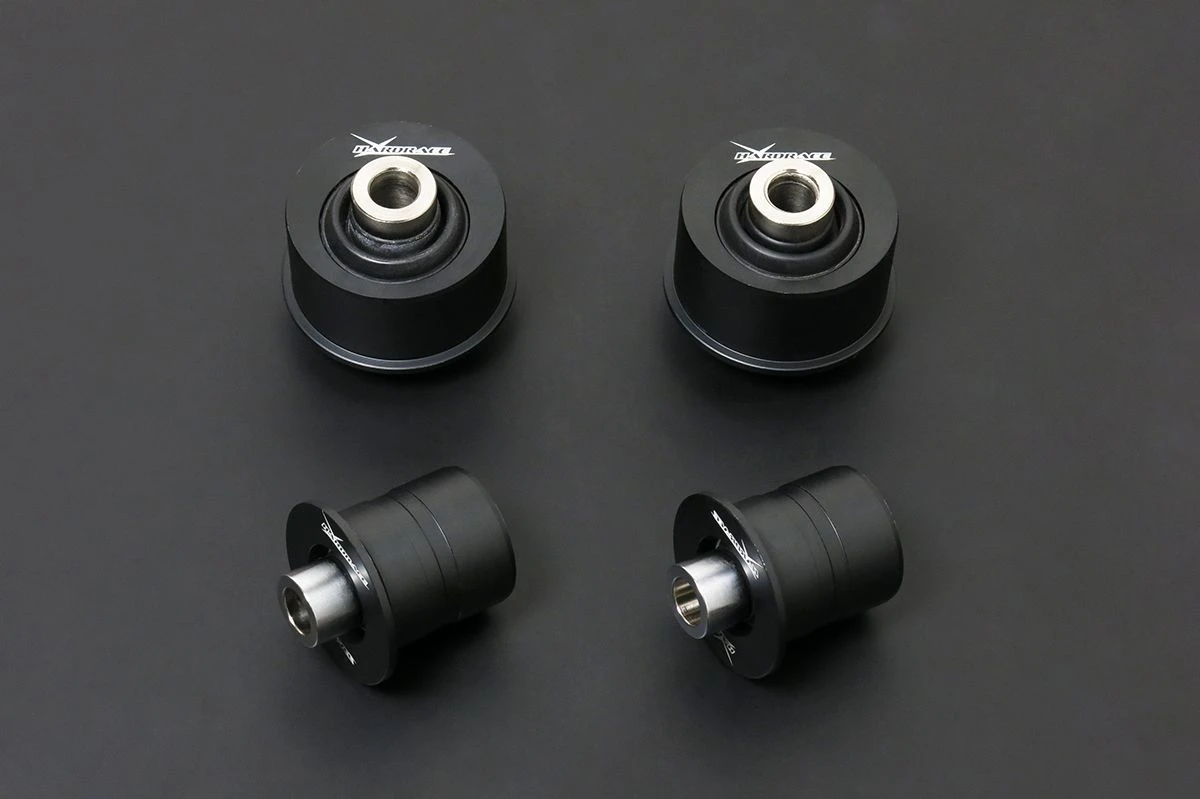 Hardrace Front Lower Arm Bushes Caster Increase Spherical For Honda Civic Integra EP3 DC5 01-05
For serious grip and steering precision where comfort matters less than response and control.
From £385.73
How do I fit replacement bushings?

You have chosen your required bushings and the hardness, and now you want to fit them into your car. Bushings can come in two main types: two-piece bushings, two halves of a bush and a metal insert.
For many people, the hardest part is not fitting the new bushes; it is removing the old ones without damaging the arm or housing.
That is why bush replacement is often easier when you already have the suspension apart for other work, such as coilovers, arms or an alignment refresh.
If you do not have access to a press, it is often worth removing the arms yourself and taking them to a garage to have the old bushes pressed out and the new ones installed correctly.
The second type is a metal outer with a bonded polyurethane insert, which will need pressing in using a press. To achieve the correct camber and castor gain, it is vital to ensure the bushes are fitted in the correct orientation, especially with offset bushes.
It is also a good idea to book a proper alignment after fitting suspension bushes.
Even if the old settings looked fine before, fresh bushes can remove play and shift the way the car sits under load, so the alignment should be checked again if you want the car to drive properly.
SuperPro has the most extensive range of aftermarket polyurethane bushes available, currently manufacturing more than 8000 products in Brisbane, Australia.
One of the biggest benefits of quality aftermarket bushes is that they are designed specifically to improve the bush itself, rather than simply meeting the comfort and cost targets expected of an OEM road car.
SuperPro embraces the concept of developing a higher quality, quieter, longer-lasting alternative to standard rubber bushings.
Conclusion
Overall, neither rubber nor polyurethane is automatically better in every situation.
Rubber still makes the most sense for comfort-focused daily driving, while polyurethane is usually the stronger choice for drivers who want sharper handling, better steering feel and more consistent suspension control.
If you want the best balance, think about how the car is really used rather than just buying the stiffest option available. In many cases, the right bush choice can transform how connected and confidence-inspiring the car feels without needing much more power.
If you need help choosing the right bushes for your setup, feel free to contact us, and we will point you in the right direction.