
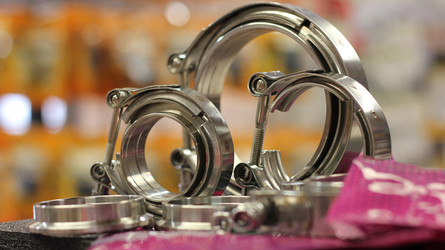
What Is A V-Band Clamp? Exhaust Guide
Posted by Matthew Marks on 9th May 2025
What Is A V-Band Clamp, And When Should You Use One?
A practical guide to V-band clamps, exhaust flanges, turbo joints, gasket-free sealing and where they make the biggest difference on a modified car.
We use V-bands on our own exhaust builds because they make hot, awkward exhaust sections much easier to remove and refit without fighting old bolts and gaskets.
Shop Stainless Steel V-Band ClampsIf you have ever removed an old exhaust flange and found rounded nuts, snapped studs, a blown gasket or soot marks around the joint, you already know the problem V-band clamps are designed to solve.
A V-band clamp gives you a compact, strong, 360-degree exhaust joint that can be undone with one fastener. That is why they are common on turbo downpipes, wastegate pipes, custom exhausts, backboxes and removable centre sections.
The simple answer
A V-band clamp is a circular clamp with a V-shaped inner profile. It pulls two matching weld-on flanges together evenly around the full joint.
On a male and female V-band setup, the flanges locate into each other and usually do not need a gasket. The clamp then holds the joint together with even pressure instead of relying on two or three separate bolts.
Use V-bands where you want a strong, serviceable, leak-resistant joint, especially on turbo systems, downpipes, track cars and custom stainless exhausts.
- A V-band clamp joins two matching flanges with an even 360-degree clamping force.
- Male and female V-band flanges are self-aligning and usually do not need a gasket.
- They are best for downpipes, turbo outlets, wastegate pipes, centre sections and removable backboxes.
- They still need correct welding, alignment, clearance and sensible bolt positioning.
- A V-band is not a shortcut for badly routed pipework, warped flanges or poor fabrication.
Watch: In our V-band guide, we explain why we use this style of joint on custom exhaust builds and where it makes future maintenance easier.
How Does A V-Band Clamp Work?
A V-band system has three main parts: two flanges and one clamp. The flanges are welded to the pipe ends. The clamp fits over the outside of both flanges, and the V-shaped inner groove pulls them together as the nut is tightened.
The useful part is how the load is applied. A normal two-bolt or three-bolt flange clamps hardest at the bolt points. A V-band applies force around the full circumference of the joint, so the seal is more even and the joint stays compact.
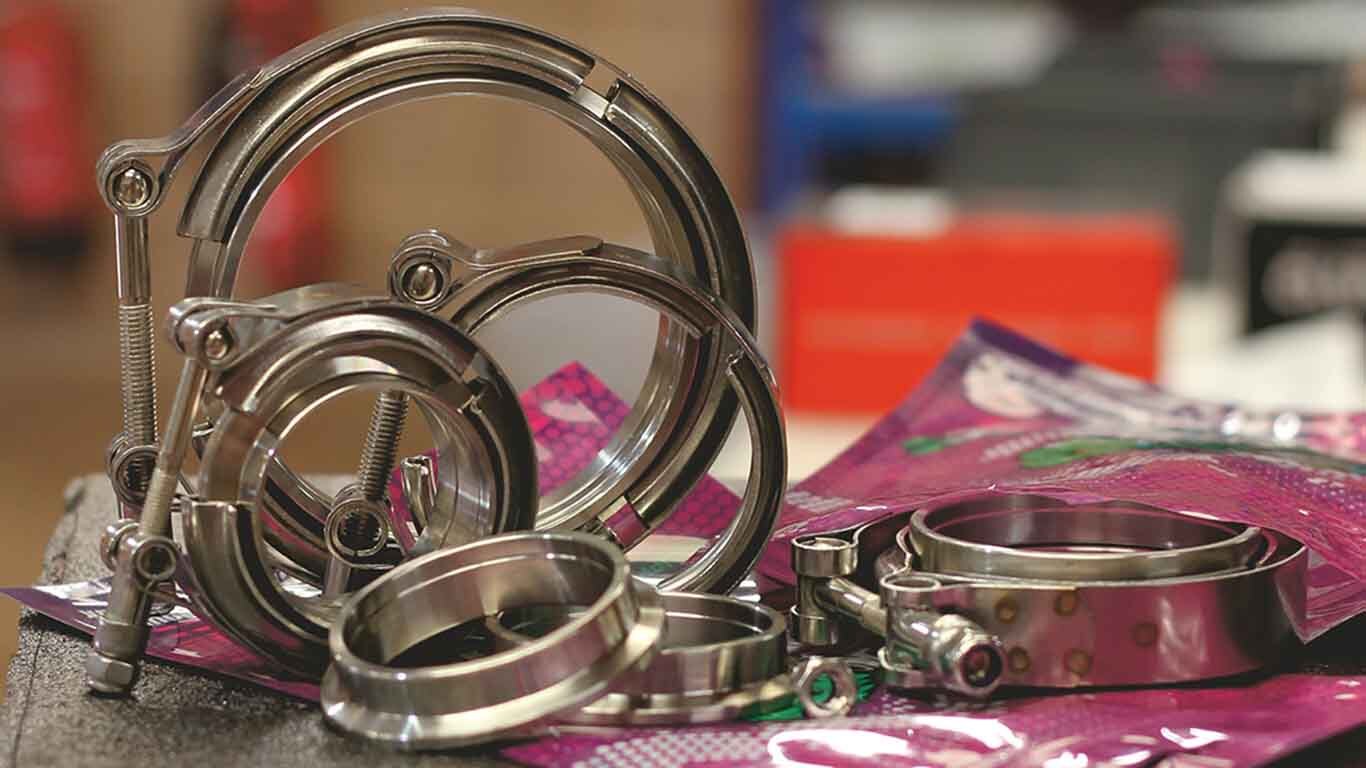
On a self-aligning male and female setup, one flange has a raised locating section, and the other has a matching recess. That helps the two halves sit in the correct position before the clamp is tightened.
Do V-Band Clamps Need Gaskets?
Most male and female V-band clamps do not need a separate gasket because the interlocking flanges create the sealing face. This is one of the main reasons they are popular on performance exhausts and turbo systems.
Some flat or symmetrical V-band flange designs may use a thin gasket, depending on the flange design and application. That is why it is important to match the clamp and flanges as a proper set rather than mixing random parts.
The Exoracing stainless steel V-band clamp with flanges uses a self-aligning design, which is the style we prefer for custom exhaust work because it is easier to locate and less fiddly to refit under the car.
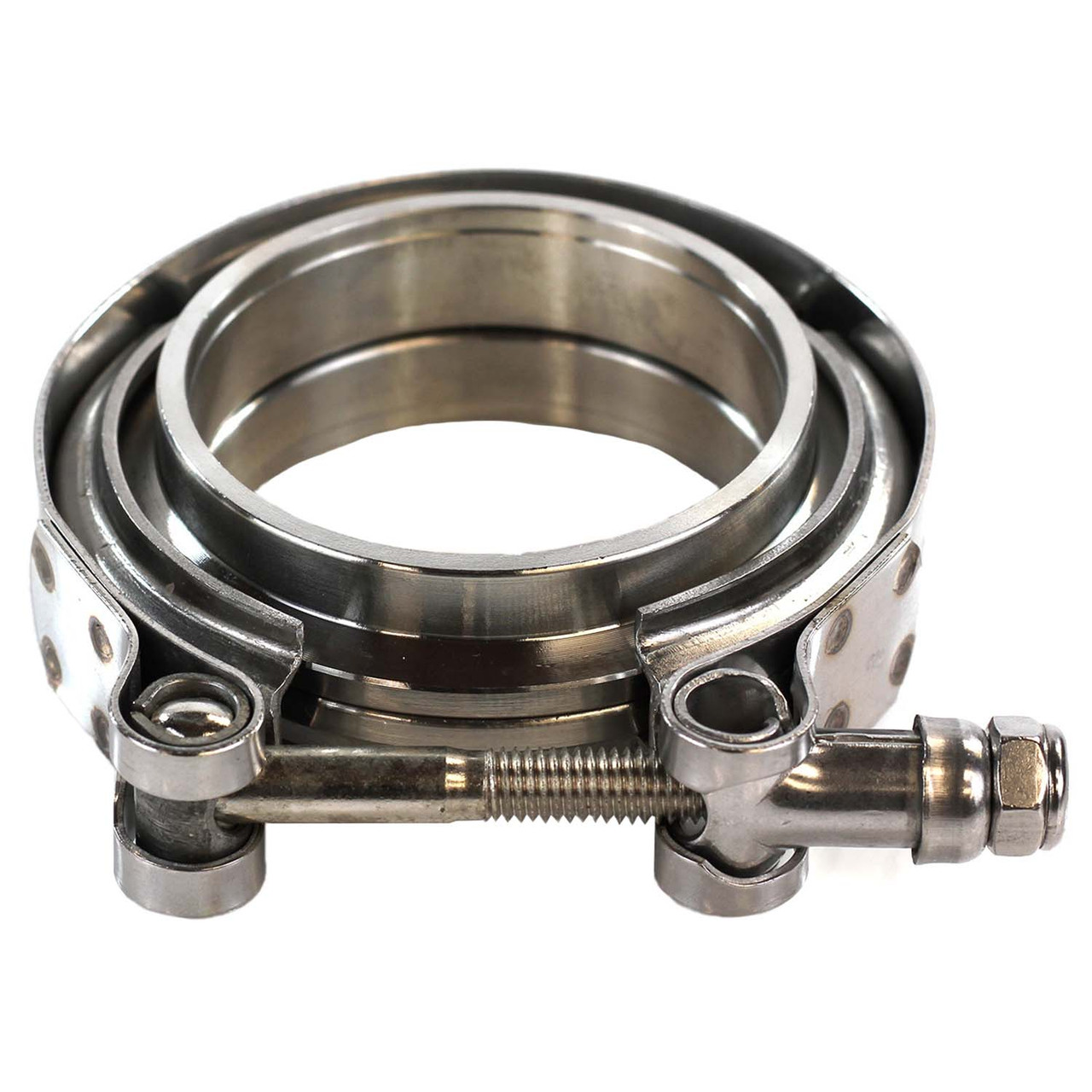 Exoracing Stainless Steel V-Band Clamp With Flanges
Self-aligning stainless V-band setup for serviceable joins on exhaust, turbo and intake pipework.
From £39.99
How To Measure A V-Band Clamp
The safest way to choose a V-band clamp is to measure the pipe and match the clamp and flanges as a set. Do not order from a rough visual guess, because a small difference in flange profile or pipe size can stop the clamp from seating properly.
For exhaust fabrication, the size usually refers to the pipe size for which the flanges are made. Measure the outside diameter of the pipe where the V-band flange will be welded, then choose the matching V-band kit for that pipe size.
Use vernier callipers or an accurate tape measure across the pipe where the flange will be welded.
A clamp from one design may not seat correctly on another brand or flange profile.
This matters when a downpipe or rear section needs to slide into place during refitting.
The pipe may fit, but the clamp still needs space around the tunnel, subframe, bumper and floor.
V-Band Clamp Sizes: What Size Should You Choose?
Choose the V-band size to match the exhaust or intake pipework you are building. Common performance exhaust sizes include 2 inch, 2.5 inch, 3 inch, 3.5 inch and 4 inch, but the correct size depends on your actual pipework, not the car model alone.
As a general fabrication rule, do not step the V-band size down smaller than the pipe unless you are deliberately building a reducer section. A smaller joint can become a restriction, while an oversized flange can be awkward to package and weld neatly.
V-Band Clamp Vs Exhaust Flange Vs Slip Joint
A V-band is not the only way to join exhaust pipework. The right choice depends on access, budget, heat, vibration and how often the system needs to come apart.
Compact, quick to remove and strong when welded and aligned correctly. Costs more than a basic flange.
Cheap and familiar, but bulkier and slower to remove. Bolts and gaskets can become the weak point over time.
Allows adjustment, but can leak or seize together and is not as positive as a proper V-band joint.
Useful in some areas, but not the same as a weld-on V-band flange system for hot performance exhaust joints.
V-Band Turbo Setups Vs T3 And T4 Flanges
On turbo builds, V-bands are useful because they let you position and service the hot side more easily. A traditional T3 or T4 flange fixes the turbo or exhaust housing position around the bolt pattern. A V-band connection can give more rotational freedom, depending on the turbo housing and manifold design.
This matters when you are trying to line up a downpipe, wastegate outlet or screamer pipe in a tight engine bay. Being able to rotate a V-band joint before final tightening can save a lot of fabrication time and make future removal less painful.
That does not mean every turbo setup must be converted to V-band. If your existing T3 or T4 manifold, turbo and downpipe package works well, the flange style may be perfectly acceptable. V-band becomes more attractive when you are already changing the manifold, turbine housing, downpipe or wastegate pipework.
This is one of the strongest use cases for V-bands on a turbo car.
Many external wastegate setups use V-band connections because access is tight and heat is high.
There is no need to redesign a working setup just for the sake of using a V-band.
Where Should You Use V-Band Clamps?
The best place for a V-band is a joint you may need to remove in the future, especially if the joint is hot, cramped or important for sealing. On our own builds, the biggest benefit is serviceability. One clamp is far easier to deal with than several heat-cycled bolts under the car.
Downpipe, centre section and rear section joints are usually more useful than replacing every single join.
They save time during inspection, repairs and exhaust changes between events.
These joints see heat, vibration and tight access, so a compact serviceable joint makes sense.
Think about how the exhaust will drop out, where tools will fit and whether the clamp bolt has road clearance.
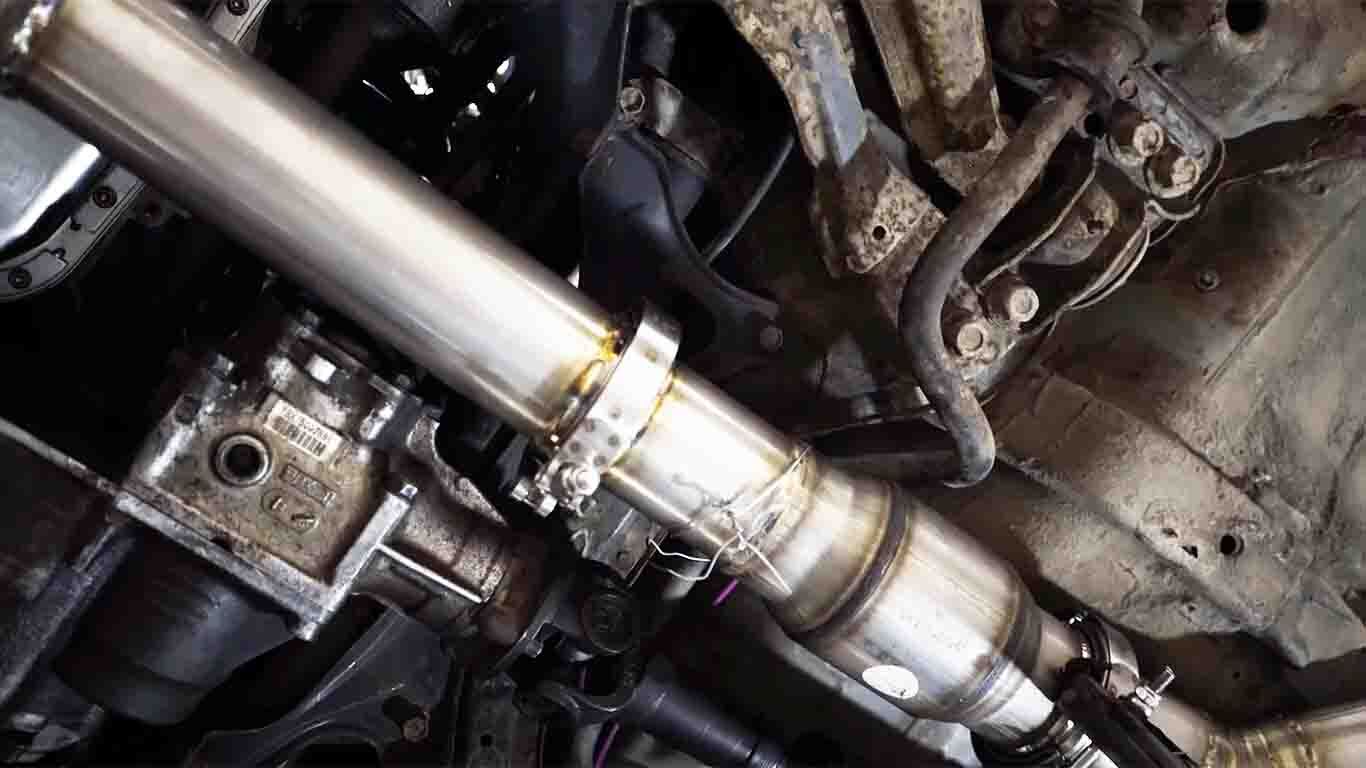
Watch: In our AWD Civic exhaust build, we use V-band clamps so the exhaust can be removed and worked on more easily later.
When Not To Use A V-Band First
A V-band is a better joint, but it does not fix every exhaust problem. If the pipework is under tension, the hangers are wrong, or the exhaust is trying to sit in the wrong place, fitting a V-band can hide the real issue for a short time rather than solve it.
Fix cracked brackets, poor hanger position, bad routing, warped flanges and clearance problems first. If the exhaust is stainless and the joint position is sensible, then a V-band is a good upgrade.
If heat is damaging nearby hoses, wiring or panels, also check the heat source and vulnerable parts around the joint. A downpipe joint near wiring may need better routing or heat management parts, as well as a serviceable exhaust connection.
Common V-Band Clamp Mistakes
Welding The Flanges Out Of Alignment
The clamp should hold an aligned joint together. It should not be used to pull badly angled pipework into position. Tack the flanges, test fit the system, then finish weld once you know the joint sits naturally.
Pointing The Clamp Bolt At The Floor
On a low road car, the clamp bolt and hinge area can become the lowest point if it is positioned badly. Rotate the clamp so the bulky section has the best possible clearance from speed bumps, kerbs and road debris.
Over-Tightening The Clamp
More force does not always mean a better seal. Over-tightening can distort the clamp or damage the flanges. Tighten to the clamp manufacturer's guidance and recheck after heat cycling.
Mixing The Wrong Clamp And Flange Styles
A V-band clamp must match the flange profile. Do not assume any clamp will fit any V-band flange just because the pipe size looks close. Mismatched parts can leak, sit unevenly or fail to clamp properly.
What Happens If You Ignore A Bad Exhaust Joint?
A leaking exhaust joint is not just annoying. On a turbo car, a leak near the turbo or downpipe can leave soot marks, heat nearby components, make the car harder to work on and create repeat failures if the joint keeps moving.
If a gasket flange keeps blowing, the correction is not always another gasket. Check whether the flanges are flat, whether the pipework is supported properly and whether the exhaust is hanging naturally. If the joint needs to come apart regularly, replacing that section with a properly welded V-band can prevent the same job from becoming a repeated fight.
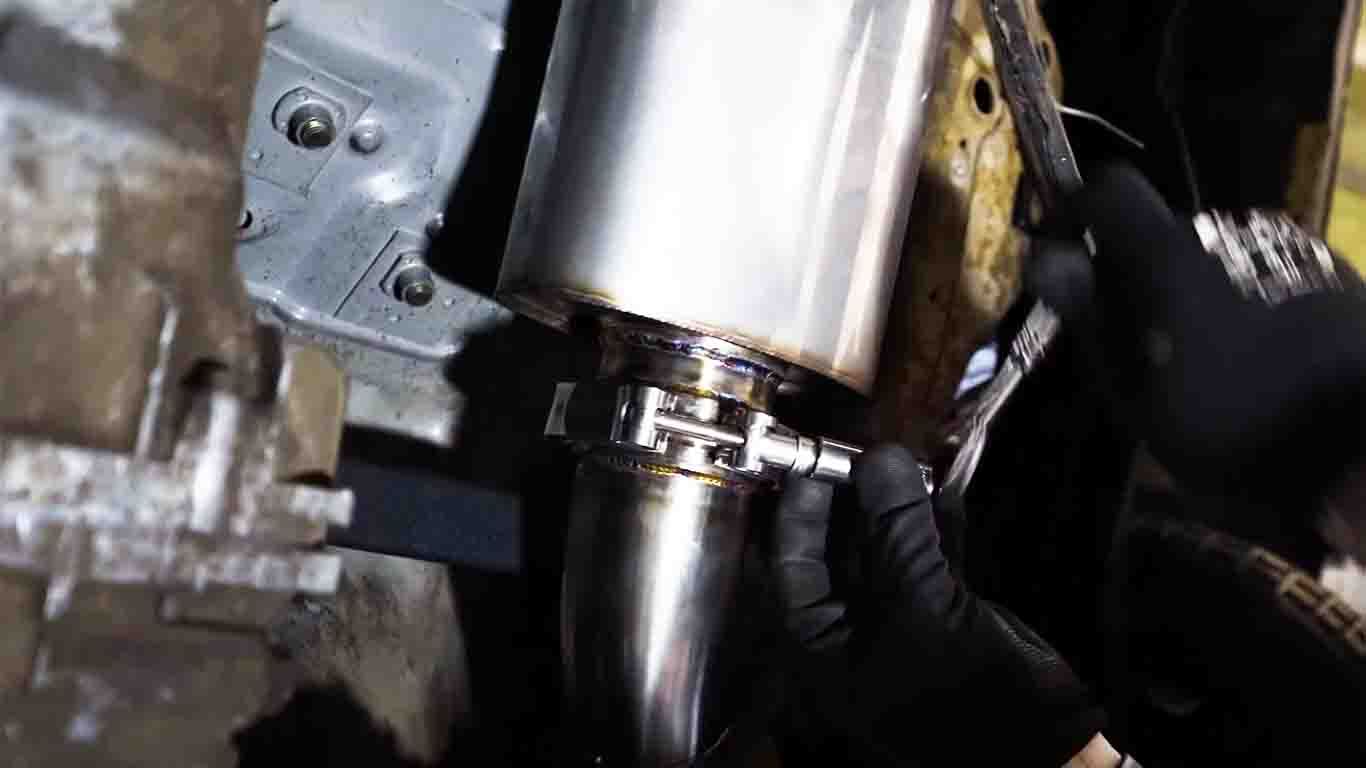
Why Do V-Band Clamps Leak?
A good V-band joint should seal cleanly, but it can still leak if the parts around it are wrong. Most V-band leaks come from alignment, flange condition, clamp mismatch or poor support rather than the V-band idea itself.
Loosen, inspect the flange faces and check whether the pipework is pulling the joint out of line.
Clean the faces and confirm the clamp and flanges are the correct matched profile.
Check hangers, mounts and clearance so the joint is not carrying the weight of the system.
Check for weld distortion, dirt, a damaged bead or the wrong male and female pairing.
How Tight Should A V-Band Clamp Be?
A V-band clamp should be tight enough to seat the flanges evenly and hold the joint securely, but it should not be forced until the clamp distorts. The correct torque depends on the clamp design, bolt size and manufacturer guidance.
The practical method is to seat the flanges correctly first, start the nut by hand, tighten the clamp gradually, then inspect that the V-band is sitting evenly all the way around. If tightening the nut is the only thing pulling the pipework into line, stop and fix the alignment.
After the first few heat cycles, let the exhaust cool and recheck the joint. Heat cycling can settle the system, especially on new fabrication, fresh hangers or a newly built exhaust.
V-Band Installation Checklist
Use this as a quick reference before welding a V-band into a custom exhaust, downpipe or rear section.
A V-band is only useful if the exhaust can drop away once unclamped.
Avoid pointing the nut into the floor, tunnel or another pipe.
Tension in the system can crack welds, cause leaks or make the clamp difficult to refit.
Heat-cycled stainless fasteners can gall if assembled dry.
Look for soot, movement, loose hardware or clearance marks.
Common Concerns About V-Band Clamps
Are V-bands worth the extra money? Yes, if the joint is hard to access, sees heat and vibration, or needs to come apart in the future. For a cheap, mild steel exhaust that will rarely be removed, a basic flange may be enough.
Can V-band clamps leak? They can leak if the flanges are warped, misaligned, dirty, mismatched or under-torqued. The clamp is only one part of the system; the fabrication still matters.
Can I fit one at home? You can bolt and unbolt a V-band at home, but welding the flanges into the exhaust should be done properly. If you are not confident welding stainless pipework, use a fabricator.
What size do I need? Match the V-band to the pipe outside diameter and the exhaust section you are building. If you are unsure, measure the pipe accurately before ordering rather than guessing from the old clamp.
FAQs
What is a V-band clamp used for?
A V-band clamp is used to join two flanged pipe sections. On cars, it is most often used on exhaust systems, downpipes, turbo outlets, wastegate pipework and removable custom exhaust sections.
How do V-band clamps work?
The clamp's V-shaped inner groove sits over the matching flange profiles. As the nut is tightened, the clamp pulls both flanges together evenly around the full joint.
Do V-band clamps need gaskets?
Male and female V-band flanges usually do not need a gasket because the interlocking flange faces create the seal. Some flat flange designs may need a gasket, so always check the specific clamp and flange type.
How tight should a V-band clamp be?
Tighten it to the manufacturer's guidance for that clamp. Do not simply tighten it as hard as possible, because over-tightening can distort the clamp or flanges and create future problems.
Are V-band clamps good for turbo exhausts?
Yes. They are a strong option for turbo downpipes, turbine outlets and wastegate pipework because they are compact, serviceable and handle hot, vibrating joints well when installed correctly.
Can I reuse a V-band clamp?
Yes, a good stainless V-band clamp can normally be reused many times. Inspect the clamp, threads and flange faces each time and replace anything distorted, cracked or badly worn.
How do I measure a V-band clamp size?
Measure the pipe outside diameter where the flange will be welded, then choose a matching V-band kit for that pipe size. If you are replacing an existing setup, also check the flange profile so the clamp and flanges match.
Is a V-band better than a normal exhaust flange?
For performance and custom exhausts, a V-band is usually better where access, sealing and repeat removal matter. A normal flange can still be fine for simple low-cost joints that rarely need to come apart.
Final Recommendation
If you are building a custom exhaust, turbo downpipe, wastegate pipe, removable centre section or backbox, a V-band clamp is one of the best upgrades you can plan into the system. It makes the joint easier to service, keeps the layout compact and removes the usual fight with old exhaust bolts and gaskets.
The key is to fit it properly. Choose the correct size, use matching flanges, weld it square, keep the exhaust supported and position the clamp so it can be reached later. If you also need exhaust parts around the joint, our exhaust parts category is a useful next place to check.
Use code BLOG5 at checkout if you are choosing a V-band clamp for your build.
Choose The Right V-Band ClampAbout The Author

Exoracing is a UK-based performance parts and heat management specialist.
Since 2018, we have helped enthusiasts and workshops choose parts for turbo builds, custom exhausts, heat protection, fuelling systems and modified road and track cars. If you need help choosing the correct size or part, contact the Exoracing team, and we can help you check the best option for your setup.