
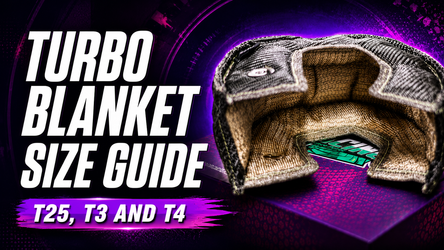
Turbo Blanket Size Guide: T25, T3 and T4
Posted by Matthew Marks on 23rd May 2026
Jump to a section
Turbo Blanket Size Guide: How to Measure T25, T3 and T4 Turbos
Not sure whether your turbo needs a T25, T3 or T4 blanket? This guide shows the two measurements that matter, how to check your turbine housing and when to size up.
At Exoracing, one of the most common turbo blanket questions we get is simple: "Which size do I actually need?" The answer is nearly always in the turbine housing measurement, not just the flange name.
Shop Exoracing Turbo Blanket V3Choosing a turbo blanket by guesswork is where fitment problems start. A blanket that is too small can leave the turbine housing exposed, while a blanket that is too large can sit loose, move around and make installation harder than it needs to be.
This turbo blanket size guide explains how to measure the hot side of the turbo, how the Exoracing T25, T3 and T4 sizes compare, and what to do if your turbo name does not match the actual housing size.
The simple answer
Measure the turbine housing circumference around the outside of the hot side, then measure the housing width across the section the blanket needs to cover. Compare those measurements with the blanket size chart before ordering.
As a starting point, the Exoracing Turbo Blanket V3 is available in T25, T3 and T4 sizes. T25 suits small OEM-style turbos, T3 suits most mid-size street and hybrid setups, and T4 suits larger turbo or higher-power builds.
Do not choose by flange name alone. A turbo can use a T3 flange but still have a large turbine housing that needs a bigger blanket.
- Measure the turbo hot side, not the compressor side.
- Use circumference and width to choose between T25, T3 and T4.
- A flange name is a clue, not a final sizing answer.
- If your turbo is between sizes, choose the size that covers the turbine housing securely without fouling moving parts.
- Check for oil leaks, damaged lines and poor clearance before fitting any turbo blanket.
Turbo Blanket Size Chart for T25, T3 and T4
Use this as the first check when choosing an Exoracing Turbo Blanket V3. The measurements below are the blanket's inner measurements published on our product page.
Best starting point for smaller OEM-style turbo housings and compact T25/T28-style applications.
The usual choice for many mid-size street, hybrid and aftermarket turbo setups.
Best starting point for larger turbo housings, bigger frame builds and setups where a T3 blanket would leave the housing exposed.
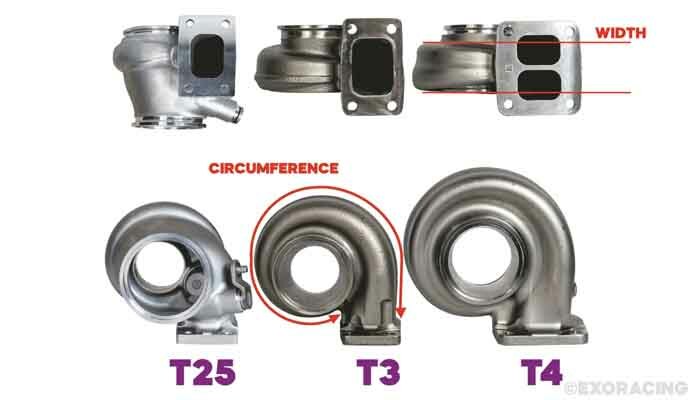
How to Measure for a Turbo Blanket
You only need two main measurements: turbine housing circumference and turbine housing width. The turbine housing is the hot side of the turbo, connected to the manifold and downpipe. Do not measure around the cold-side compressor cover.
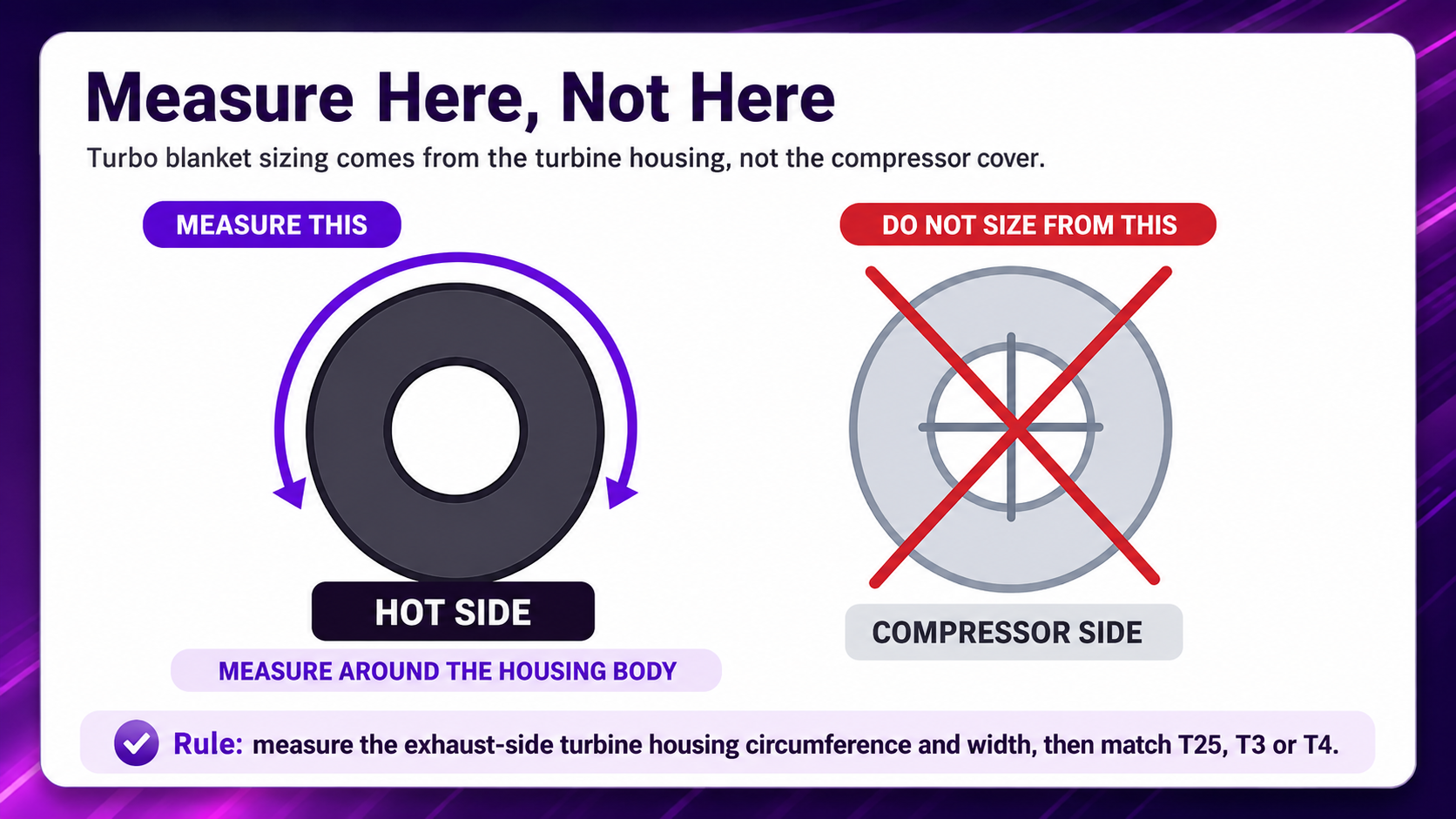
If you measure the compressor cover, the number will be wrong. Turbo blankets are sized to the hot-side turbine housing.
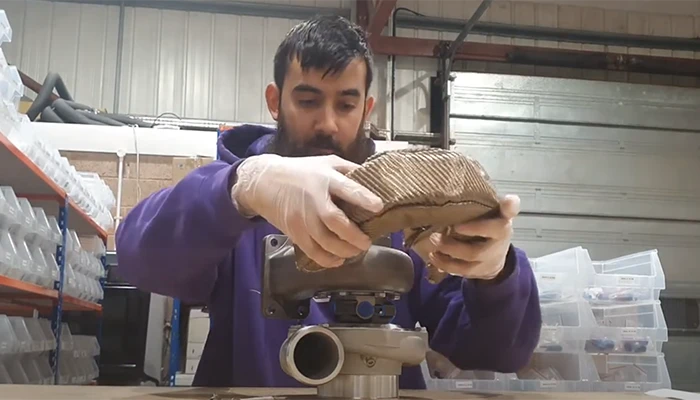
The blanket fits around the turbine housing only. Use this visual check before measuring so you do not size the blanket from the compressor side.
1. Let the turbo cool fully
Never measure or trial fit around a hot turbo. Turbine housings can stay hot long after the engine has been switched off. Let the car cool fully before reaching into the engine bay.
2. Measure the circumference around the hot side
Wrap a flexible tape measure around the outside of the turbine housing, around the main body of the hot side. Keep the tape on the housing itself, not around the inlet flange, outlet flange or compressor cover.
If access is tight, use a strip of paper, masking tape or string, mark the overlap point, then lay it flat and measure it. That is usually easier than trying to read a tape measure behind a manifold or bulkhead.
3. Measure the width across the turbine housing
Measure the width of the section the blanket needs to cover. This is the side-to-side depth of the turbine housing, not the total turbo width, including the compressor cover, actuator bracket, downpipe flange, or manifold flange.
4. Compare the measurement to the chart
Once you have both numbers, choose the blanket size that best covers the hot side. Circumference tells you how far the blanket needs to wrap around the housing. Width tells you whether the blanket will cover the turbine body without sitting too far over the flanges.
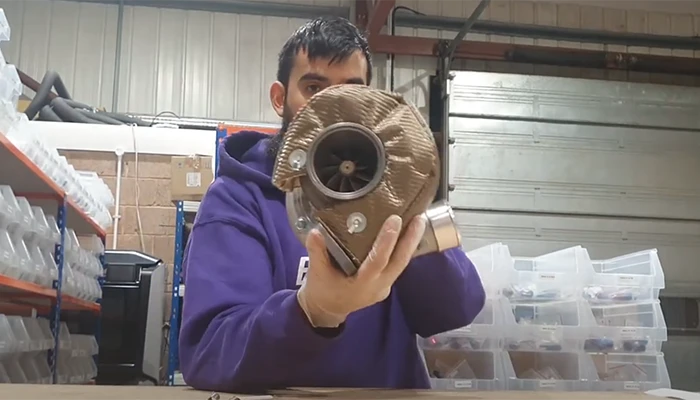
A correctly sized blanket should sit snugly around the hot side without being stretched, twisted or pulled over the compressor housing.
Quick Choice: T25, T3 or T4?
Use this decision helper if you already have a rough idea of your turbo frame but want a sanity check before buying.
Measure first, but most compact turbine housings need the smaller blanket to sit tightly.
This is often the best match for common street turbo builds, but still check housing circumference.
A bigger housing needs more blanket coverage, even if the flange name makes the turbo sound smaller.
This is the classic mistake. The flange does not always tell you the blanket size.
Why Flange Size Can Mislead You
Turbo names are useful, but they are not perfect sizing tools. T25, T3 and T4 are often used as shorthand for turbo frame or flange style, but blanket fitment depends on the physical turbine housing.
From our experience, the confusing setups are usually hybrid turbos, aftermarket housings, and builds where the turbo name is used loosely in a parts listing. A "T3/T4" turbo, for example, can mean different things depending on the housing combination.
The safe approach is to use the turbo name as a starting clue, then confirm with the tape measure. This is also why our broader turbo blanket installation guide tells you to check the size before fitting.
What Happens If the Turbo Blanket Is the Wrong Size?
Wrong sizing is not just annoying. It can reduce how well the blanket controls radiant heat and can make the installation less secure.
If the blanket is too small, it may not cover enough of the turbine housing. That leaves hot areas exposed, so nearby wiring, hoses, intake pipework, bonnet paint or plastic parts can still see direct radiant heat.
If the blanket is too large, it may sit loose, bunch up or make the spring location awkward. A loose blanket is more likely to move after heat cycles, especially on track, drift or hard road use.
We see this question a lot because people often buy by turbo label instead of housing size. The correction is simple: measure the hot side, choose the closest blanket size and recheck the fit after the first heat cycle.
Internal Wastegate, V-Band and Tight Engine Bay Checks
Some turbos need more than a basic size check. Before ordering, look at the wastegate actuator, actuator arm, compressor housing, oil feed, oil drain, coolant lines and downpipe clearance.
The blanket must not stop the actuator from moving or sit where it can rub through.
The blanket may not hug every V-band shape perfectly, so focus on secure coverage and safe spring location.
Watch for wiring, hoses, bonnet clearance, intake pipework and anything that could contact the blanket after heat cycles.
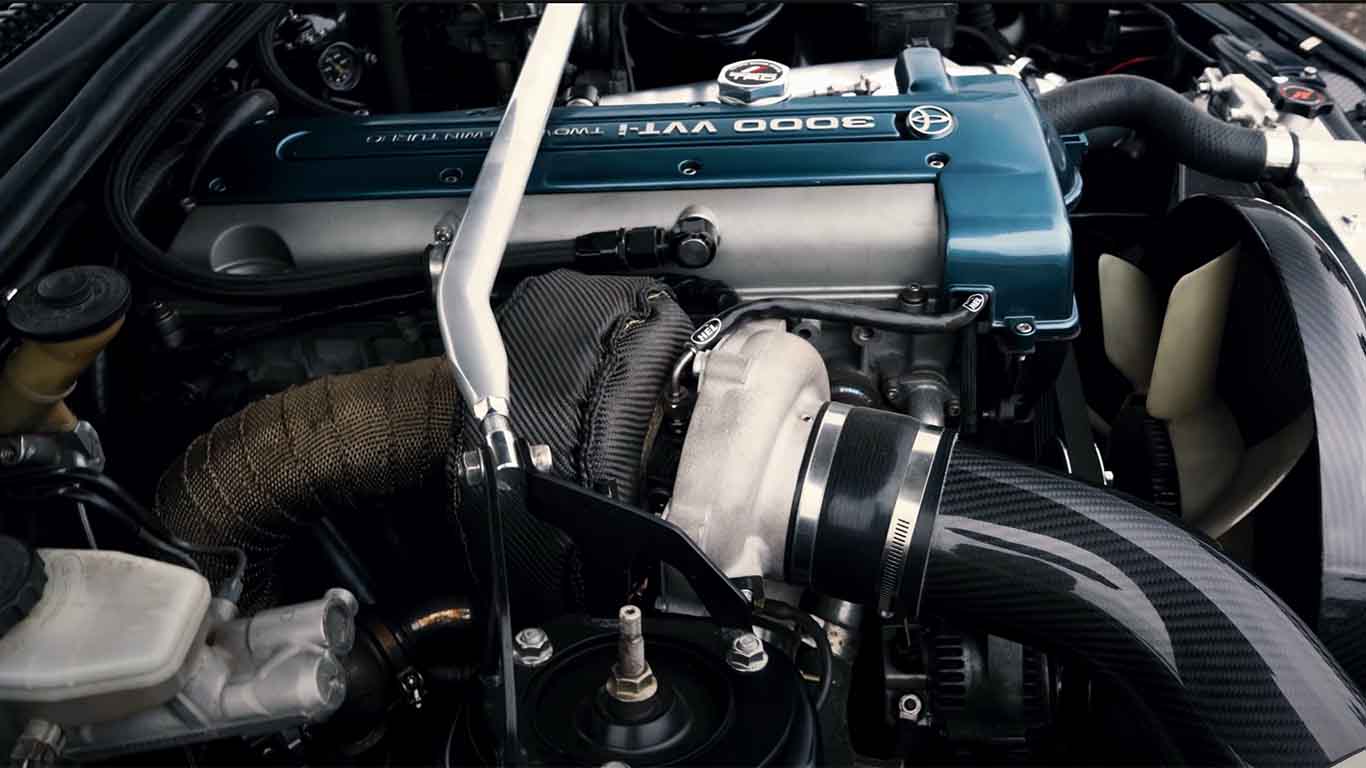
A real engine bay check matters because the turbo blanket has to work around the parts near the turbo, not just the turbo housing on its own.
Best Product for T25, T3 and T4 Turbo Blanket Fitment
If your measurements match the chart, the Exoracing Turbo Blanket V3 is the direct product path. It is available in T25, T3 and T4 sizes, titanium or carbon exterior finishes, and includes stainless steel spring fasteners.
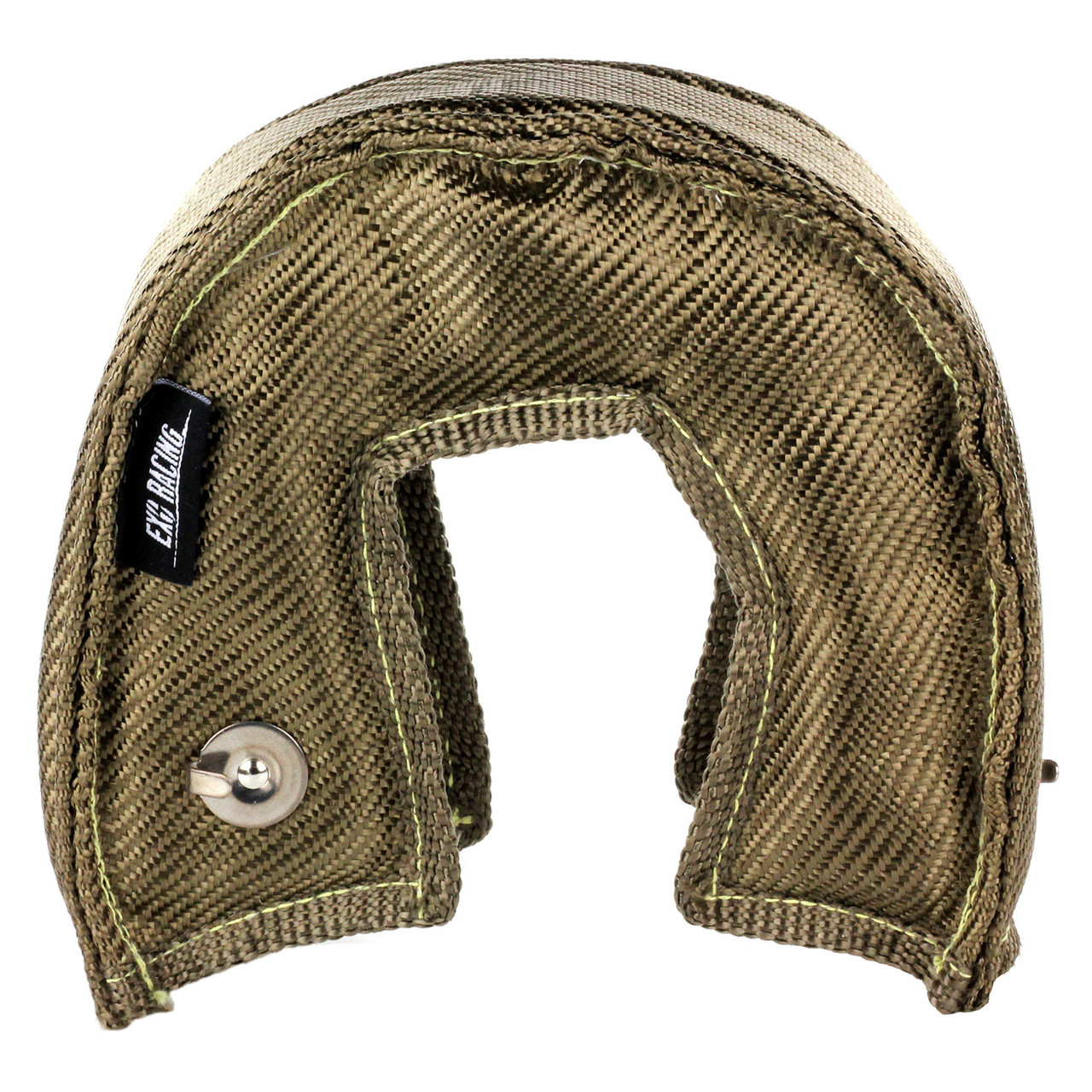 Exoracing Turbo Blanket V3
T25, T3 and T4 turbo blanket options for containing turbine housing heat at the source.
From £119.99
Common Turbo Blanket Sizing Mistakes
Choosing by flange name only
A T3 flange does not always mean a T3 blanket is correct. Measure the housing and use the flange name only as supporting information.
Measuring the compressor side
The blanket fits the turbine housing. Measuring the cold side gives the wrong answer and can make the blanket look like it should be much larger than it really needs to be.
Ignoring the actuator arm
If the blanket blocks or rubs the actuator arm, it is not fitted correctly. A secure fit is important, but so is keeping all moving parts free.
Fitting over leaks or damaged parts
A turbo blanket should only be fitted to a clean, safe turbo area. If there is oil, coolant, fuel residue or damaged wiring nearby, fix that first. Our turbo blanket fire safety guide explains why contamination changes the risk.
When a Turbo Blanket Is Not the First Fix
A turbo blanket is for controlling turbine housing heat. It is not a shortcut for unsafe routing or mechanical faults.
Do not fit a blanket until you have checked for oil leaks, damaged oil feed or drain lines, loose fittings, brittle wiring, damaged coolant hoses and anything that could touch the blanket once the engine moves under load.
If the turbo is not the only heat source, think about the full hot side. The first section of the downpipe, manifold, screamer pipe or nearby wastegate can still radiate heat. For a wider setup, start from our heat management parts category and match each product to the heat source and vulnerable part.
Install and Recheck After the First Heat Cycle
Once you have the right size, fit the blanket when the car is cold, seat it evenly around the turbine housing and secure it with the supplied springs. After the first full heat cycle, let the car cool and check that the blanket has not moved.
Watch: In our install video, we show how a turbo blanket sits on the turbine housing and why checking the fit before the first heat cycle matters.
If you want proof of why controlling turbo heat matters, our turbo blanket blowtorch test shows how the blanket material behaves under controlled heat, while our before and after RS4 turbo blanket test shows how source control can affect surrounding engine bay areas on a real car.
Turbo Blanket Size FAQs
What size turbo blanket do I need?
Measure the turbine housing circumference and width, then compare them with the size chart. T25 is usually for smaller OEM-style turbos, T3 for mid-size street or hybrid setups, and T4 for larger turbine housings.
Is T3 or T4 based on the flange?
Not completely. The flange name is only a clue. Turbo blanket fitment depends on the physical turbine housing size, so always measure before ordering.
Can I use a T4 turbo blanket on a T3 turbo?
Only if the turbine housing measurement suits the T4 blanket. Some large T3-flanged turbos may need more coverage, but a blanket that is too large can sit loose or foul nearby parts.
Should a turbo blanket cover the whole turbo?
No. A turbo blanket covers the turbine housing, which is the hot side of the turbo. It should not cover the compressor wheel area, belts, actuator movement or anything that needs to stay free.
What if my turbo is between two blanket sizes?
Look at coverage and clearance together. You want enough coverage over the turbine housing, but not so much extra material that the blanket sits loose or touches the actuator, compressor side or surrounding parts.
Can I fit a turbo blanket myself?
Yes, many turbo blankets can be fitted at home if access is good. The important steps are choosing the right size, working on a cold turbo, securing the springs and checking the blanket after the first heat cycle.
Can a turbo blanket catch fire if it is the wrong size?
Wrong size is mainly a fitment and heat-control issue. The bigger safety concern is contamination from oil, fuel, coolant or power steering fluid. Fix leaks before fitting any blanket and replace a blanket that has become heavily contaminated.
Conclusion: Measure the Housing, Then Choose the Size
The best turbo blanket size is the one that fits the turbine housing securely, covers the hot side properly and leaves safe clearance around moving parts, oil lines, coolant lines, wiring and nearby pipework.
Use the turbo name as a starting point, but make the final decision from the hot-side circumference and width. If your measurements line up with T25, T3 or T4, choose the matching Exoracing Turbo Blanket V3, then recheck the fit after the first heat cycle.
Shop T25, T3 and T4 Turbo BlanketsAbout the Author
Exoracing is a UK-based performance parts and heat management specialist run by enthusiasts who work with turbo, exhaust, cooling, wiring and engine bay protection products every day.
Since 2018, we have helped customers choose parts for road cars, track cars, swaps and high-power turbo builds, with practical advice based on product testing, install experience and real customer questions.