
Do Turbo Blankets Work? Blowtorch Test Results
Posted by Matthew Marks on 31st Dec 2025
Jump to a section
Our blowtorch demonstration shows how the blanket behaved under direct local heat. It is useful evidence of a thermal barrier, with limits that matter when choosing parts for a car.
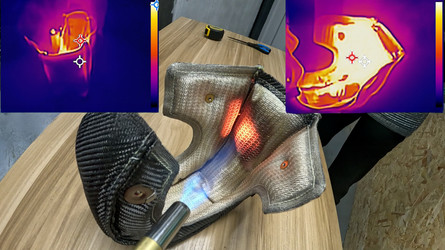
We exposed an Exoracing Turbo Blanket V3 to a propane blowtorch, recorded thermal-camera readings and inspected the material afterwards. The outside stayed much cooler than the flame-facing area in the recorded demonstration. The inner mesh also suffered local damage.
The result supports the blanket’s role in limiting heat transfer. It does not measure a percentage reduction in heat flow, certify fire safety or predict an exact engine-bay temperature drop.
Watch: Our direct-flame demonstration, two runs, recorded readings and material inspection.
If the player is blocked, watch the video on YouTube.
The method and the limits
We used one blanket, a propane torch, a thermal imaging camera and a timer. The first run was cut short after the flame-facing reading reached the camera’s reported 580°C range limit and we had trouble keeping the flame stable. We then logged the outer face in a separate three-minute run.
A blowtorch puts heat into a small area. A turbine housing heats over a different area and sees changing gas flow, load, airflow and heat cycles. This was a demonstration of the material under local heat, rather than a controlled copy of road or track use.
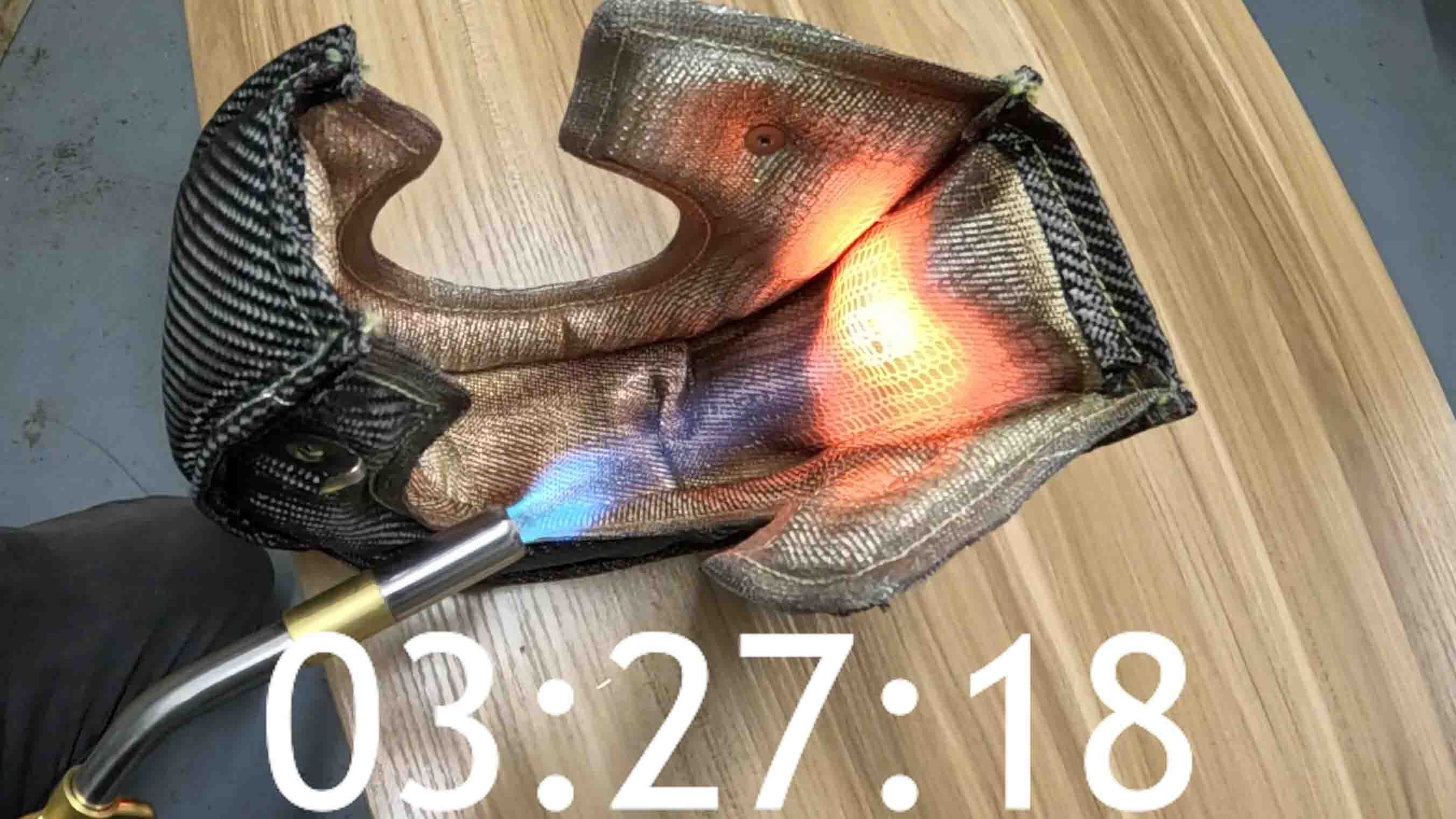
The blanket and torch setup used in our demonstration.

The first run reached the camera’s reported range limit.
The outside-face readings
These are the published readings from the separate timed outer-face run. Keep the times and readings together when comparing them with the footage.
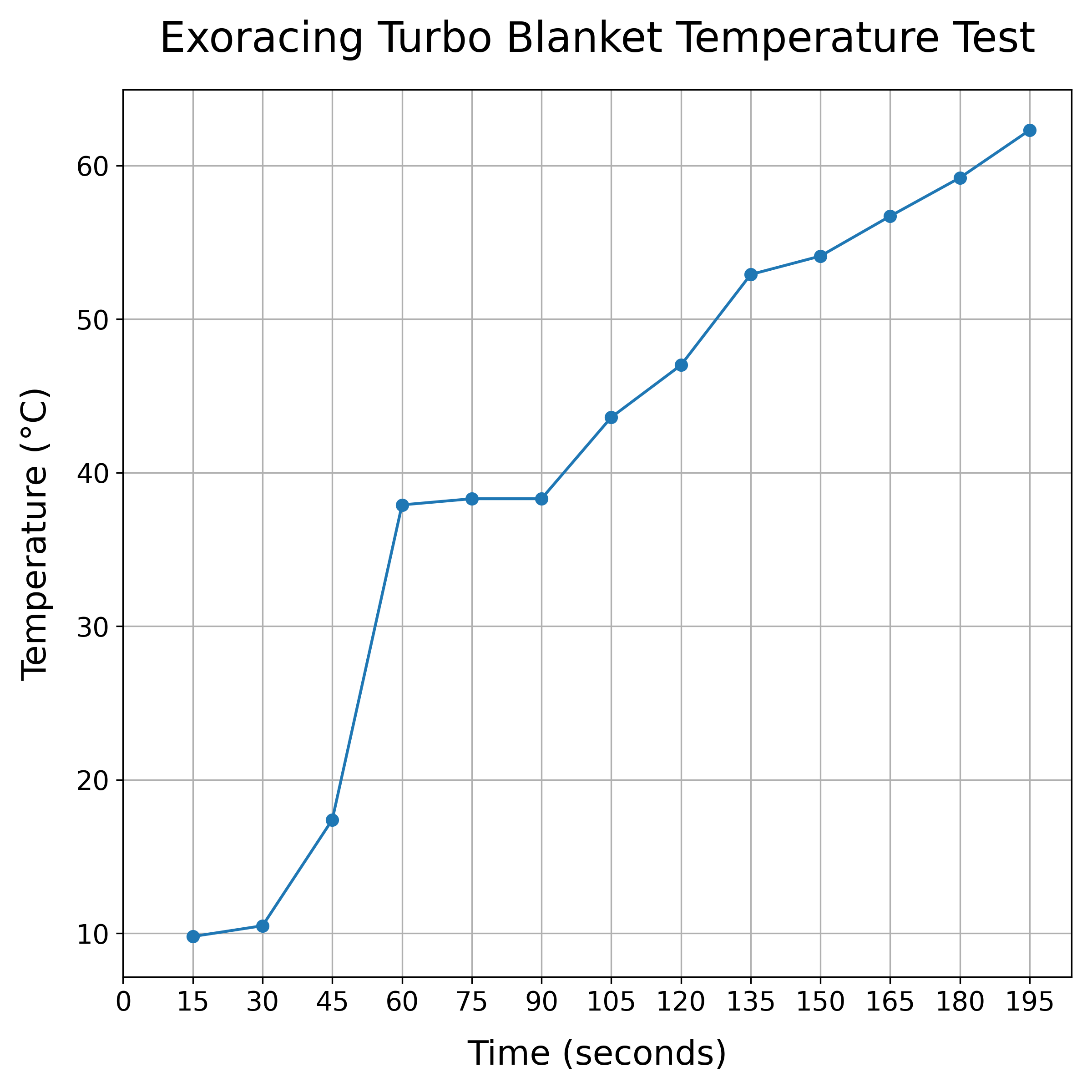
The recorded outer-face trend during the timed run.
Why we do not quote a heat-reduction percentage
Two surface readings do not measure how much heat passed through the blanket. A ratio made from Celsius readings is not a valid percentage reduction in heat transfer. The camera reaching its range limit adds a further constraint: it did not record an exact hot-side peak.
A thermal camera also needs suitable settings for the surface. Emissivity means how that surface emits infrared radiation. Reflections can affect the result too. FLIR’s measurement guidance explains why range, emissivity and reflected temperature matter. The demonstration does not supply a complete calibrated set of those conditions for a lab efficiency calculation.
Use the footage and recorded trend to understand what happened. Do not use them to promise a fixed heat-flow reduction, horsepower gain, spool change or outside temperature on another installation.
What happened to the material?
After the demonstration, we inspected the mesh, outer weave, stitching and insulation. The flame-facing mesh had local damage. In the areas shown, the outer weave had not visibly burned through, and the blanket did not ignite during the recorded test.
The damaged mesh is an observation, not a reliable thermometer. Its appearance alone does not establish the alloy, its exact peak temperature or the cause of each damaged strand. Surviving this demonstration also does not certify long-term durability or safe use when contaminated by oil or fuel.

The outside weave after the demonstration.
What does this mean on a real turbo car?
A turbo blanket fits around a compatible turbine housing, the hot exhaust side. Its useful job is limiting radiant heat reaching nearby hoses, wiring, intake parts and panels. It does not belong on the compressor housing, manifold or downpipe.
For a vehicle comparison, see our 550bhp RS4 before-and-after test. Alex’s intake-temperature logs showed about 7°C lower on average in that comparison. That result still belongs to the RS4 and its before-and-after conditions.
Choose a blanket because the turbine housing is the heat source and nearby parts need protection. If the exhaust pipework is the source, consider suitable wrap or a shield. If a healthy line remains exposed after routing checks, a sleeve may help. The heat protection selector separates those jobs.
 Exoracing Turbo Blanket V3
Source control for a compatible, clean turbine housing near vulnerable components.
From £119.99
Fitment, leaks and smoke still matter
- Inspect only when fully cold. Repair leaks, damaged lines and poor routing first. Never cover fuel or oil contamination to hide a fault.
- Measure the actual turbine housing. Check both dimensions against the blanket size guide. A T25, T3 or T4 label alone does not establish fit.
- Keep the blanket and fasteners clear of actuator arms, wastegate linkages, the compressor side and other parts that must move. Follow the V3 installation guide.
- Inspect again after the first heat cycle, once cold. Heavy or lasting smoke, fresh fluid residue or an oil or fuel smell needs investigation. Stop using the car when safe and get help if the cause is unclear.
The current V3 product listing states a working rating up to 1200°C / 2192°F. That is a supplier product rating, not a temperature validated by this demonstration or permission to use it on any hot component. The turbo still needs its specified oil supply, coolant flow where required and correct installation.
Choose from the problem, then check the result
Our demonstration gives you visible material behaviour, timed surface readings and an inspection afterwards. Use it alongside actual fitment, the condition of the car and the heat path you need to control. It is a reason to investigate suitable protection, not a reason to fit a bundle to every car.
Send us the turbo model, turbine-housing measurements and a clear photo if you are unsure of fit. If the car is overheating or leaking, diagnose and repair that first.
View Turbo Blanket V3About Exoracing
Matt runs Exoracing, a UK business specialising in heat management and performance parts. Since 2018, we have helped enthusiasts and workshops choose parts using practical product knowledge, installations and testing.